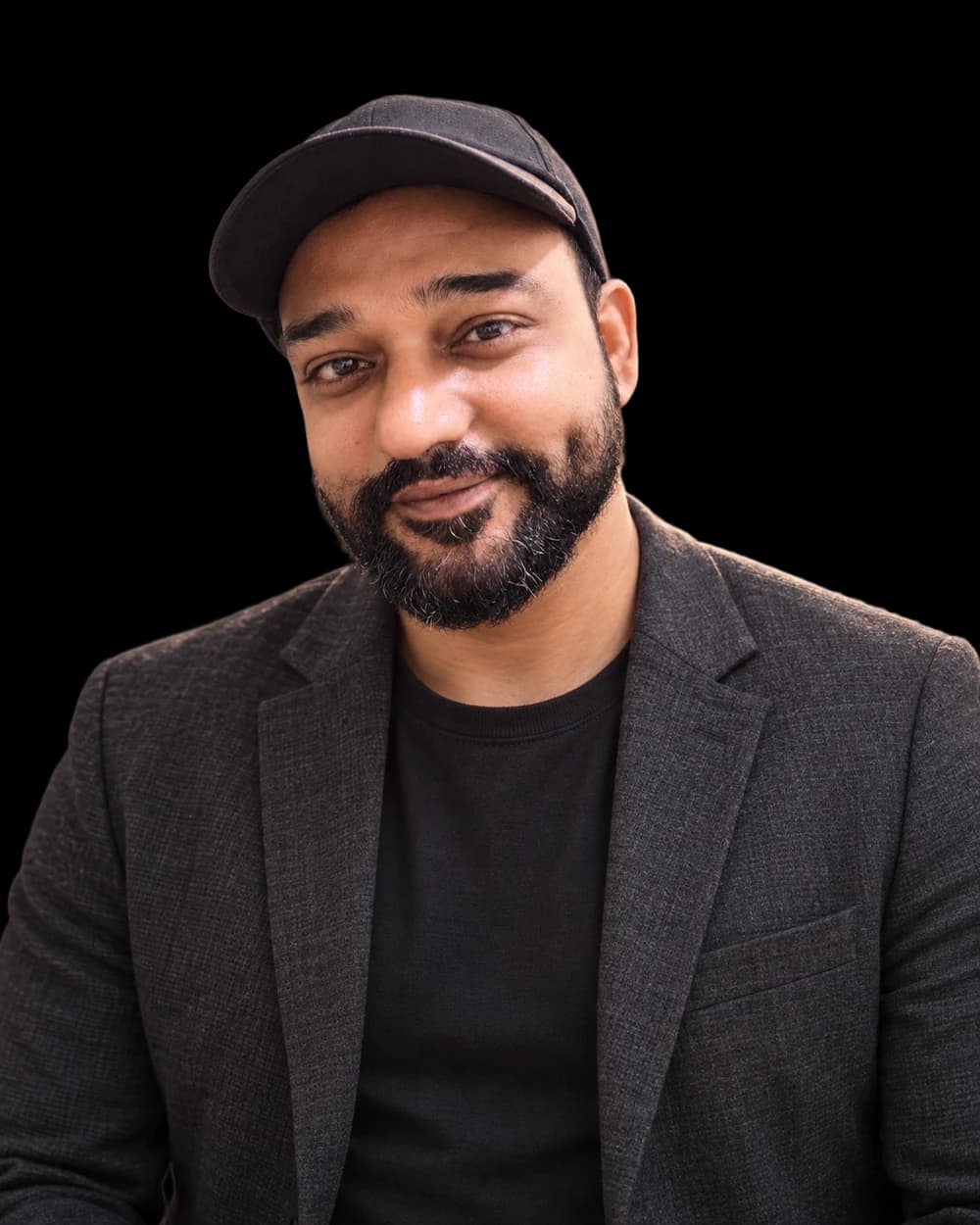
A builder across disciplines.
I’m Darshankumar Joshi, a technologist and builder from India. My background brings together business computing, enterprise software, web development and visual storytelling. Long before today’s conversation about AI agents, I was working on the practical connections between technology and the people who use it: helping businesses become discoverable online, supporting enterprise workflows and developing digital experiences.
My earlier website described that mix simply: code, shoot, direct and innovate. That curiosity still connects the work. A software system and a visual story ask different things of their creator, but both depend on understanding context, making deliberate choices and communicating clearly.
Today, my focus is on AI systems, developer tools and creative technology. The question behind the work remains consistent: how can an ambitious idea become something useful, understandable and maintainable?
Ideas shared beyond the workbench.
Building is one part of the journey. Sharing ideas with a wider community is another. In 2025, that journey included an invitation and appreciation from Team Techfest, IIT Bombay, and a public-speaking appearance for the Government of Gujarat in Gandhinagar.
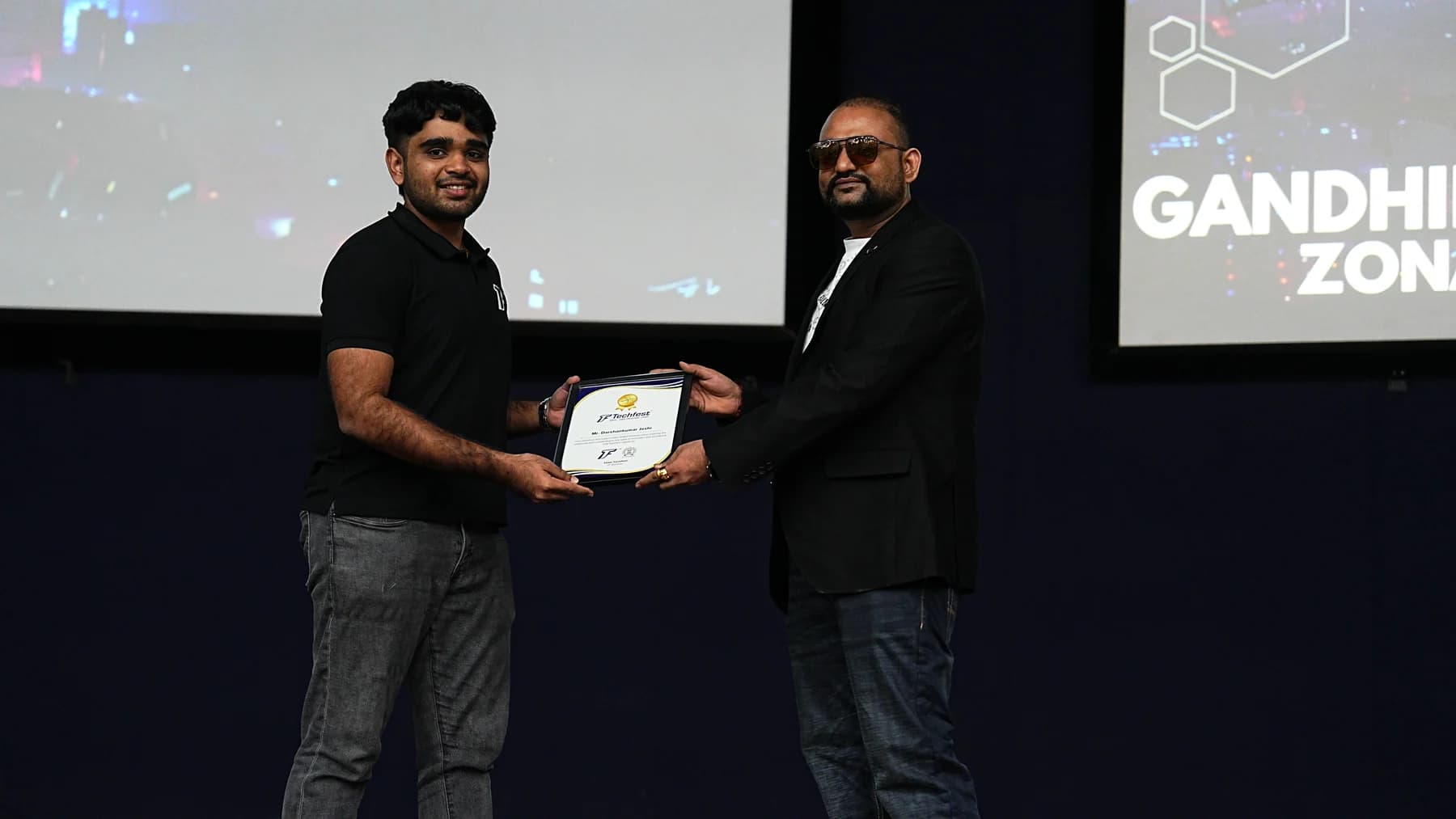
Invited and appreciated · Team Techfest, IIT Bombay
I was invited and recognised by Team Techfest, IIT Bombay, in 2025. The certificate of appreciation acknowledges my presence and support, and my contribution to the community’s spirit of innovation and excellence.
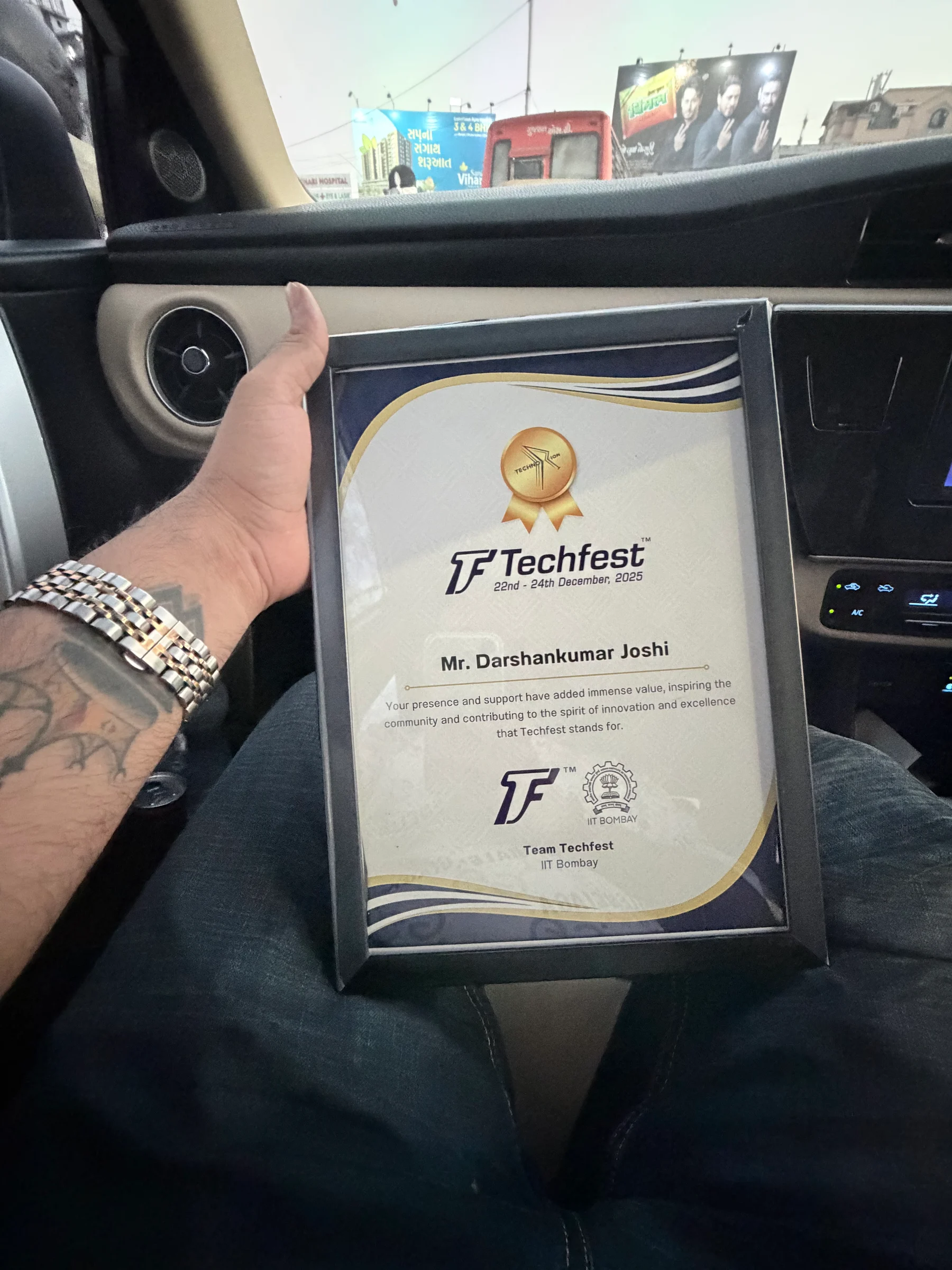
Acknowledging presence, support and community.
This recognition is part of a broader journey across technology, entrepreneurship and creative work—a moment of connection with a community built around ideas and innovation.
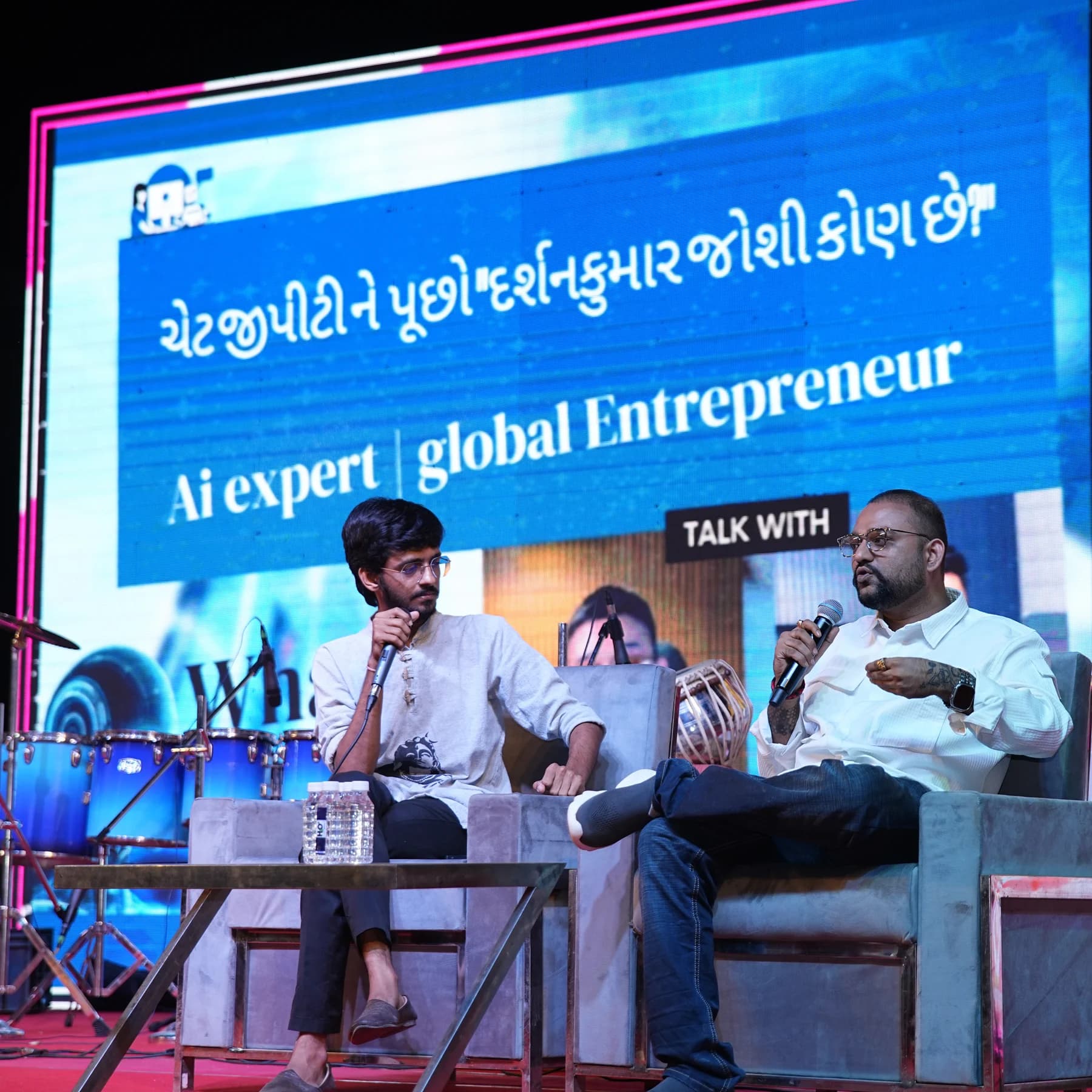
Public speaking · Gandhinagar, Gujarat
In 2025, I also took part in a public-speaking engagement for the Government of Gujarat in Gandhinagar. The on-stage conversation brought my work in AI and entrepreneurship into a public forum, creating space to share a perspective shaped by hands-on technical and business experience.
The journey so far.
My path has moved between hands-on consulting, entrepreneurial work and creative production. These earlier chapters explain the mix of technical and human concerns I bring to a project.
2009–2010 · SEO consulting
At Sidco, a UK-based construction business, I worked on search-engine optimisation while studying business computing at the University of Greenwich. It was an early connection between technical work and commercial communication: helping a business present itself and become easier to find online.
2011–2012 · Enterprise systems at Aimtron
As an ERP consultant at Aimtron Electronics in Vadodara, I worked with Epicor in an electronics manufacturing services environment. My responsibilities included ERP implementation and configuration, PHP-based intranet modules, website maintenance and email marketing. This work connected business operations with software implementation and day-to-day support.
2013–2017 · Independent technology consulting
I worked with businesses and organisations across South Gujarat, combining technical delivery with the realities of running a business. My earlier résumé lists work associated with Hackeinste.in, Domainsnmore.com, Microtronix Solutions, Pahi Events, Pick’a’Deal, Hotel Royal Regency and Universal Welfare Trust. Working alongside entrepreneurs helped shape my approach to understanding requirements, making practical decisions and taking responsibility for delivery.
From May 2017 · GraymatterOnline
I became a director and partner at the co-owned venture GraymatterOnline LLP. The practice brought together website and application development, SEO and digital marketing, distributed ledger technology, augmented and virtual reality advertising, visual effects and professional editing. My 2020 and 2021 profiles record this chapter as a place where business technology and creative production came together.
That breadth is part of the foundation for my current interest in connected systems: understanding how infrastructure, interfaces, information and creative decisions influence one another.
Business thinking. Technical foundations.
2009–2010 · Business Computing (Honours)
University of Greenwich. My archived résumé lists a bachelor’s qualification in Business Computing, connecting the study of computing with organisational and business needs.
2007–2009 · Advanced Diploma in Information Technology
University of Sunderland. An earlier foundation in information technology, preceding my business computing studies.
Code, camera and curiosity.
Visual storytelling has been part of my practice alongside software. My earlier portfolio included work on The Indian Drug Chronicles, a documentary web-series project intended to build awareness of drug use and its physical and psychological effects among young people in India. It also documented website redesign and social-management work for Universal Welfare Trust.
These experiences sit alongside the less visible work of ERP configuration, intranet development and maintaining a company’s digital presence. Together, they reflect a recurring interest: using different tools to communicate, solve a problem and help people make sense of something complex.
I bring that same curiosity to AI and immersive technology. The medium can change; attention to the person using it remains essential.
Career dates and education above are drawn from my earlier portfolio. The GraymatterOnline entry reflects the role recorded in those snapshots.
Intelligence needs context.
The industry’s direction makes that intersection increasingly relevant.
Google’s Android XR initiative combines immersive computing with AI assistance. Its April 2026 update introduced features including spatial placement of applications, improved interaction and enterprise-management support. These developments suggest a practical ambition for XR: moving beyond isolated demonstrations toward environments people can use for sustained work and everyday activities.
NVIDIA is approaching a related challenge through physical AI. In March 2026, the company announced models, simulation frameworks and robotics partnerships intended to accelerate deployment in real-world environments. This is a different application domain from consumer XR, but both developments point toward software that must interpret context beyond a text box.
The editorial conclusion is straightforward: understanding a model is only one part of building the next generation of products. Developers must also understand interaction, infrastructure and the consequences of action.
For Joshi, that is a stronger foundation for global positioning than a catalogue of trending technologies. AI, AR and VR become meaningful when connected to a specific problem.
From possibility to practice.
Consider an augmented-reality maintenance assistant. Recognizing equipment is one task. Retrieving the correct manual, respecting access permissions, presenting instructions clearly and escalating uncertainty are separate engineering responsibilities. A convincing demonstration might solve the first task. A dependable product must address all of them.
Or consider a virtual training environment. Its value depends on more than visual realism. The simulation needs credible scenarios, useful feedback and a way to assess whether learning transfers into practice. AI can make an experience more responsive, but good instructional design determines whether that responsiveness helps.
These are illustrative opportunities, not claims about products Joshi has already delivered. They show where a background spanning technical and creative work can support a distinct professional proposition.
That proposition should be precise:
Intelligent systems that people can understand, operate and improve.
In enterprise AI, this means connecting models to workflows with clear permissions, observable actions and measurable outcomes. In AR and VR, it means designing experiences around attention, comprehension and practical use. In infrastructure, it means treating latency, operating cost, privacy and recovery as product requirements from the beginning.
Let the work make the case.
Global authority in this field will be earned through visible evidence. Published technical explanations, inspectable software, carefully documented case studies and candid accounts of engineering trade-offs can make expertise legible across markets. A useful case study explains the starting problem, the implementation, the measured result and the limits of the evidence. That gives prospective collaborators something more substantial than a promise.
Joshi’s opportunity is to build this body of work around a coherent theme. His public profile already spans technology and creative practice. The next step in positioning is to demonstrate how those disciplines inform one another: how systems thinking improves an immersive experience, how interaction design improves an AI workflow, and how engineering discipline turns an ambitious concept into a maintainable product.
The emerging technology conversation needs people who can connect these questions. For Darshankumar Joshi, the strongest global narrative is a clear commitment to that work—and a growing public record that makes the commitment verifiable.